Temporary vs Permanent Blast Rooms: Which Is Right for Your Business?
Investing in additional blasting capacity does not necessarily mean committing to a permanent facility.
For some businesses, a permanent blast room forms an essential part of day-to-day production and provides the capacity needed for years of operation. For others, blasting requirements may be driven by a particular contract, shutdown, maintenance programme or temporary increase in workload. In these circumstances, a temporary or containerised blast room can provide the required capacity without the commitment of a permanent installation.
So, when comparing temporary vs permanent blast rooms, which approach is right for your business?
The answer depends on more than the initial cost. Project duration, production volumes, available space, component dimensions, future demand and operational flexibility all need to be considered.
What is a temporary blast room?
A temporary blast room provides controlled abrasive blasting capacity for a defined period without requiring a business to invest immediately in a permanent installation.
This could include hiring a purpose-designed containerised blast room that can be introduced to support a particular contract, shutdown, maintenance programme or temporary increase in production.
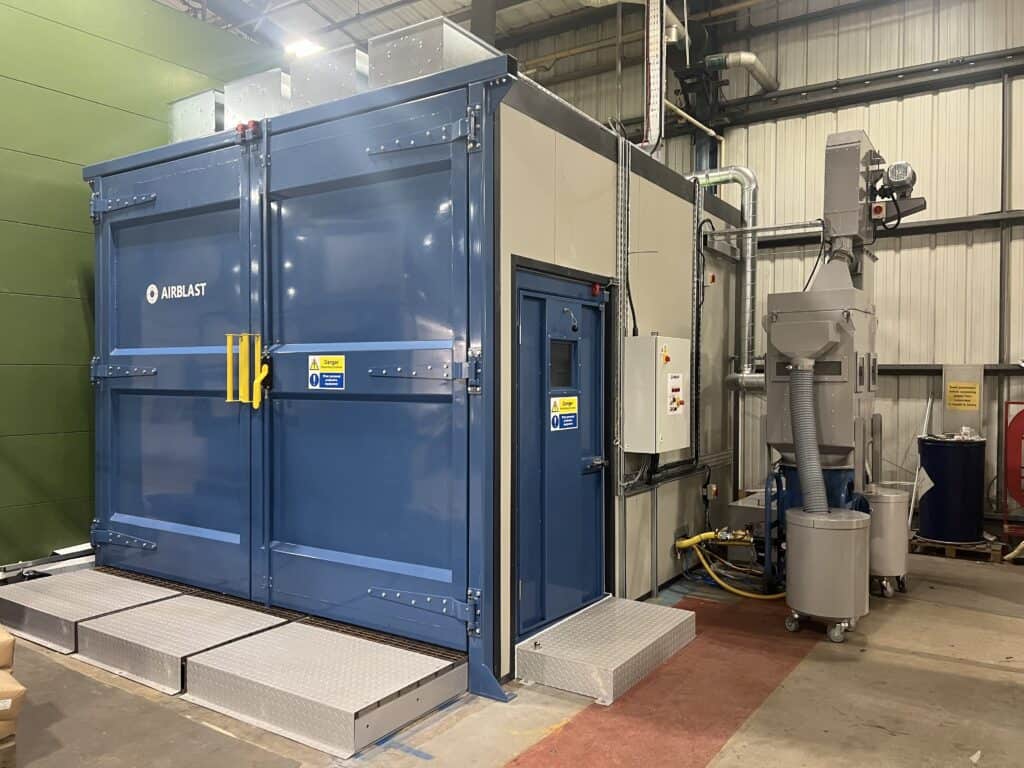
Airblast currently offers a 6m all-in-one containerised blast room for short- or long-term hire. The unit incorporates an active blasting area alongside the equipment needed to support the process, including integrated dust extraction, a blast pot, purpose-built lighting, abrasive-resistant lining, a media reclamation system, breathing-air equipment and operator training.
The customer must still provide suitable power and compressed air, while the site must have sufficient space and access for the facility. Component dimensions also need to be checked against the available blasting area before hire is arranged.
A temporary blast room can be particularly useful for:
- Short- and medium-term contracts
- Planned shutdowns and maintenance programmes
- Temporary increases in production
- Sites without an existing blasting facility
- Businesses testing demand before making a permanent investment
- Relieving pressure on an existing blast room
- Projects requiring blasting capacity at a particular location
Rather than designing a permanent facility around a requirement that may only exist temporarily, blast container hire allows businesses to access additional capacity for as long as it is required.
What is a permanent blast room?
A permanent blast room is designed as a long-term part of a business’s production or maintenance operation.
Airblast supplies blast rooms in standard, modular, containerised, weatherproof and fully bespoke configurations. This means that a permanent installation can be developed around the components being processed, the required throughput, available manufacturing space and the wider production environment.
Depending on the application, a permanent facility may incorporate:
- Abrasive delivery and recovery systems
- Dust extraction and ventilation
- Purpose-designed lighting
- Abrasion-resistant linings
- Noise-control measures
- Bespoke doors and access arrangements
- Tracks, trolleys or lifting systems
- Controls and safety equipment
Blast rooms contain abrasive and dust within a dedicated environment, while recovery and recycling systems can separate reusable abrasive from dust and debris. This can reduce waste and abrasive consumption while supporting a more efficient blasting process.
For businesses where abrasive blasting is a regular and predictable part of production, a permanent facility can provide greater long-term capacity and allow the blasting process to be integrated more closely with surrounding operations.
Temporary vs permanent blast rooms: what should you consider?
There is no universal answer to which type of blast room is better. The right solution depends on what the facility needs to achieve both now and in the future.
Before deciding, there are several important factors to consider.
1. How long will you need the blasting capacity?
Project duration is one of the clearest starting points. If additional blasting capacity is required for a specific contract, maintenance programme or temporary production increase, installing a permanent facility may involve more infrastructure than the requirement justifies.
A temporary blast room can provide a more flexible solution where the operational need has a defined end point. However, if blasting is expected to remain a core part of production for many years, a permanent blast room may provide better long-term value.
It is also worth considering what happens after the current project finishes. Is there a strong pipeline of similar work, or is future demand uncertain? Understanding this can help prevent a short-term requirement from driving an unnecessarily large permanent investment.
2. What production volume do you need to achieve?
Throughput is another important consideration. A business processing components occasionally will have very different requirements from a manufacturer blasting products throughout multiple shifts.
Consider:
- How many components need to be processed?
- How large are they?
- How frequently will blasting take place?
- How will components enter and leave the room?
- Will blasting become a production bottleneck?
- Is demand relatively consistent or highly variable?
For sustained, high-volume production, a permanent facility can be designed around the required workflow and capacity. Where demand fluctuates or additional capacity is only required periodically, a temporary solution may offer greater flexibility.
3. What space is available?
The available site can significantly influence the decision. Installing a permanent blast room requires sufficient space not only for the room itself but also for associated equipment, access, material handling and maintenance.
The position of the facility also needs to make sense within the wider production flow. A containerised or modular blast room can be useful where a business does not have suitable internal space for a permanent facility or needs to establish blasting capacity in another part of a site.
However, temporary does not mean that space planning can be ignored. Access, services, loading and unloading, surrounding operations and the dimensions of the components being blasted all still need to be considered.
4. What are you blasting?
The size, shape and weight of the components being processed are fundamental to blast room design.
A containerised blast room can be highly practical for components that comfortably fit within its working dimensions. If products are particularly large, heavy or difficult to manoeuvre, however, the physical constraints of a containerised system may make a bespoke permanent room more appropriate. A permanent facility provides greater opportunity to design the room around the workpiece and its movement through production. This may include consideration of doors, floor loading, lifting equipment, tracks, trolleys or other material handling arrangements.
The question is therefore not simply whether a blast room will fit on the site, but whether the work can move through it efficiently.
5. What level of investment makes sense?
Initial capital expenditure is an important consideration, but it should not be viewed in isolation.
A permanent blast room can represent a substantial investment, particularly where civil works, extraction, recovery systems, material handling and integration with existing infrastructure are required. However, a well-designed and properly maintained blast room can remain operational for many years, potentially making it the more economical option where demand is consistent and long term.
Its lifetime operating cost will be influenced by factors including:
- How intensively the room is used
- The abrasive being processed
- Dust extraction and filter maintenance
- The type of recovery system
- Replacement of liners and other wear parts
- Preventative maintenance
- Operator practices
For a temporary project, tying up capital in infrastructure that may no longer be required when the work ends can be difficult to justify. Hiring a containerised blast room provides another route, allowing the cost to be considered against the duration and value of the project.
Hire costs will vary according to the hire period and location. Businesses must also account for site preparation, transport, power, compressed air, consumables and any additional PPE required.
The most useful comparison is therefore not simply hire price versus purchase price. It is the total cost of providing the necessary blasting capacity over the period for which it will be used.
Summary
| Consideration | Temporary blast container hire | Permanent blast room |
| Project duration | Suited to defined or uncertain requirements | Suited to ongoing, long-term demand |
| Production volume | Useful for temporary or supplementary capacity | Better suited to sustained, predictable throughput |
| Component size | Limited by the container’s working dimensions | Can be designed around larger or unusual components |
| Initial investment | Avoids the same upfront capital commitment | Higher initial investment |
| Flexibility | Can be hired for short or long periods | Becomes a fixed part of the operation |
| Site requirements | Requires access, space, power and compressed air | May require more extensive infrastructure and integration |
| Process integration | Primarily provides additional blasting capacity | Can be integrated with handling and surrounding production |
| Long-term costs | Hire and supporting costs continue for the hire period | Ownership, servicing, energy and maintenance costs apply |
| Customisation | Limited by the hired unit’s configuration | Standard, modular or fully bespoke options are available |
| Best suited to | Contracts, shutdowns, demand peaks and uncertain workloads | Regular production and established long-term requirements |
When does blast container hire make sense?
Blast container hire can provide a practical middle ground between making do with insufficient capacity and investing immediately in a permanent facility.
Airblast’s all-in-one hire unit provides a purpose-designed blasting environment with integrated extraction, lighting, abrasive reclamation and operator equipment. This is different from assembling a basic temporary blasting enclosure, where ventilation, containment, lighting and abrasive handling may need to be planned and sourced separately. These elements remain essential to visibility, productivity and effective dust control in any temporary blasting area.
Blast container hire may be appropriate when:
- A contract requires additional capacity for a defined period
- A shutdown creates a temporary increase in maintenance activity
- An existing facility has reached capacity
- Blasting is required at a site without a permanent room
- A business wants to test its likely level of demand
- Capital investment is not currently appropriate
- The components fit within the container’s working dimensions
- Suitable power, compressed air and site access are available
The physical limitations of the container must be assessed carefully. Airblast’s current hire unit has an active blasting space of approximately 4m long, 2.352m wide and 2.393m high. The component itself, any handling equipment and the space needed by the operator must all be considered.
When is a permanent blast room the better investment?
Temporary solutions provide flexibility, but there comes a point where repeatedly accommodating a long-term requirement with temporary capacity becomes inefficient. A permanent blast room is generally more appropriate where blasting is a consistent and integral part of operations.
This may be the case when:
- Blasting takes place regularly throughout the year
- Production volumes are high and predictable
- Components require a particular room size or handling arrangement
- The blasting process needs to integrate closely with other production stages
- Efficient abrasive recovery is a priority
- The business expects its blasting requirements to continue or increase over the long term
A bespoke blast room can be designed around these requirements from the outset. This is particularly valuable where the facility needs to support a defined production process rather than simply provide additional blasting capacity.
Consider the whole operation, not just the blast room
Whether temporary or permanent, the blast room itself is only one part of an effective blasting facility.
The wider system may need to consider abrasive delivery and recovery, dust extraction, ventilation, lighting, operator access, compressed air supply, waste management and material handling. How these elements interact can have a significant effect on productivity and operating costs.
For example, a room that is large enough for the workpiece but creates inefficient loading and unloading could restrict throughput. Similarly, insufficient consideration of abrasive recovery could increase manual handling and downtime.
Looking at the entire blasting process can therefore provide a much clearer picture of which solution offers the best operational fit.
Think about where the business is heading
Current requirements matter, but so do future ones. If production volumes are expected to increase, components are becoming larger or blasting is likely to become a more significant part of the business, a permanent facility designed with future capacity in mind may offer better long-term value.
If workloads are contract-led and likely to fluctuate, retaining the ability to add or remove capacity may be more valuable than investing in a fixed installation.
Neither approach is inherently better. The right choice is the one that aligns the facility with the way the business actually operates.
Finding the right blasting solution
Choosing between temporary and permanent blast rooms requires a clear understanding of the work being undertaken, how long the requirement will last and how the facility needs to fit into the wider operation.
A temporary or containerised blast room can provide valuable flexibility for contracts, shutdowns and changing production demands. For businesses with consistent, long-term blasting requirements, a permanent bespoke facility can offer greater integration, capacity and long-term value.
At Airblast, we help businesses assess both temporary and permanent blasting requirements. Our solutions range from short- and long-term hire of an all-in-one containerised blast room to standard, modular and fully bespoke permanent installations.
By considering factors such as component dimensions, throughput, abrasive handling, extraction, available space and future production requirements, we can help identify the approach that makes practical and commercial sense for your operation.
Planning additional blasting capacity? Speak to the Airblast team about blast container hire or a permanent blast room designed around your production requirements.