Hire vs Purchase: Making the Right Equipment Decision
Choosing whether to hire or purchase blasting and spraying equipment is a strategic decision that affects cash flow, productivity, and operational risk. For contractors and facility managers, the right choice depends on how often equipment is used, the type of projects being undertaken, and how much responsibility the business wants to carry for upkeep and compliance.
Rather than being purely a financial question, the hire vs purchase equipment decision is about matching assets to workload and business priorities.
This guide explores the key factors to consider when weighing up equipment hire versus ownership for surface preparation and coating operations.
Understanding the two options
Hiring equipment
Hiring provides access to professional blasting or spraying equipment for a fixed period without the commitment of ownership. It is commonly used for:
- Short-term or one-off projects
- Specialist or less frequently used machinery
- Situations where additional capacity is needed at short notice
Hire costs are typically treated as operating expenses, making budgeting simpler and avoiding large upfront payments.
Purchasing equipment
Buying equipment requires a higher initial investment but gives long-term access and full control. It is often preferred when:
- Workloads are steady and predictable
- Equipment is used regularly
- A specific configuration is required
Ownership turns equipment into a business asset that can be depreciated over time, contributing to long-term value if utilisation is high.
Key factors to consider
1. Cost and cash flow
Hiring spreads expenditure across the duration of a project, helping to protect working capital and avoid tying up funds in rarely used machinery. This can be especially valuable for smaller businesses or those working on contract-based projects.
Purchasing requires capital investment but can become more economical where equipment is used consistently. Over time, the cost per job can reduce significantly once the initial outlay has been recovered.
2. Project duration and frequency
For short-term, irregular, or specialist work, hired equipment is often more practical. It avoids paying for machines that may sit idle between contracts.
Where equipment is needed daily or weekly in a production environment, ownership may offer better availability and long-term value, with no dependency on hire schedules.
3. Flexibility and scalability
Hiring offers a high degree of flexibility. Different machines can be selected for different applications, and capacity can be increased or reduced as project demands change.
Ownership offers less flexibility but more certainty. Operators become familiar with the same equipment, which can improve efficiency and consistency, particularly in controlled production settings.
4. Maintenance and compliance
With hired equipment, servicing and inspection are generally handled by the supplier. This reduces internal workload and helps ensure machines remain safe, compliant, and fit for use.
With purchased equipment, responsibility sits with the owner. This includes:
- Routine servicing
- Replacement of wear parts
- Record keeping for inspections and safety checks
This approach requires technical knowledge, planning, and dedicated budget.
5. Technology and obsolescence
Hiring makes it easier to access newer or specialist technology without committing to ownership. This is useful when:
- Specifications change between projects
- New processes are being trialled
- Equipment is only needed occasionally
Ownership can be advantageous when a stable setup is required and long-term control over configuration and upgrades is important. However, it also carries the risk of technological obsolescence if processes or standards change.
When hiring makes sense
Hiring blasting or spraying equipment may be the better option if:
- Projects are short-term or variable
- Specialist machinery is only needed occasionally
- Predictable costs are preferred
- Internal maintenance resources are limited
- Capacity needs to increase quickly for peak demand
When purchasing makes sense
Purchasing equipment may be more suitable if:
- Equipment is in regular or continuous use
- Long-term costs favour ownership
- Full control over availability and setup is required
- There is in-house capability to manage servicing and inspections
- The same equipment is used across repeat applications
A balanced approach
Many businesses adopt a hybrid strategy, owning core equipment while hiring additional or specialist machines when required. This reduces capital spend while preserving flexibility and access to a wider range of technology.
This approach also limits the risk of investing heavily in equipment that may only be needed occasionally or for specific contracts.
How Airblast can support your decision
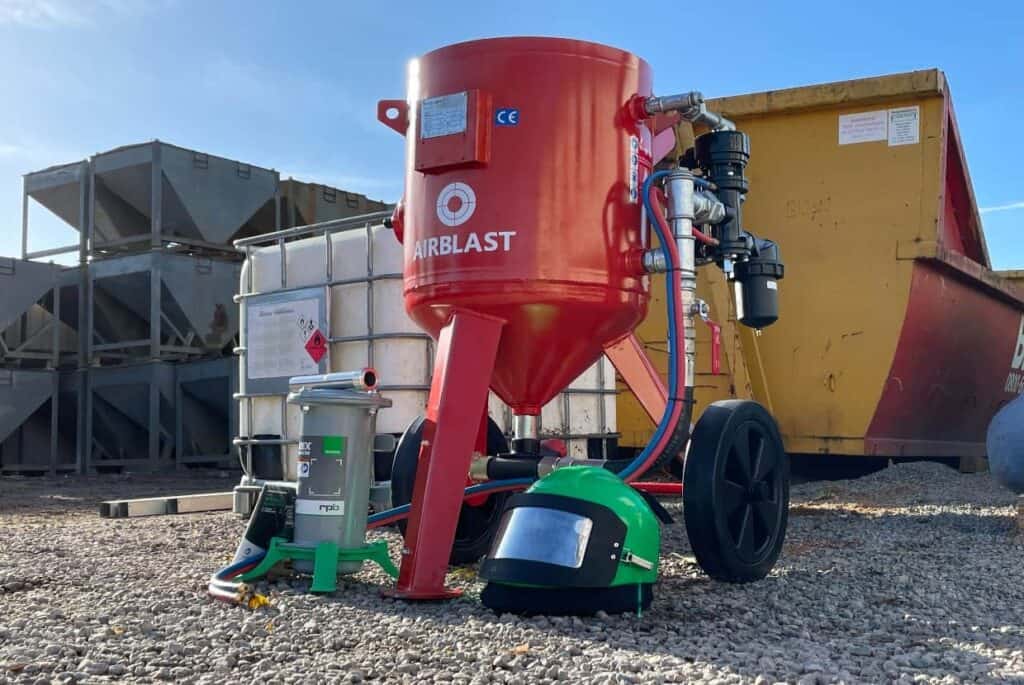
Airblast Limited supports both routes, supplying blasting and spraying equipment for purchase alongside professional hire solutions for short- and long-term projects. This allows businesses to select the most suitable option for each job, based on workload, technical requirements, and available resources.
Whether investing in long-term assets or hiring for a specific contract, the priority should be aligning equipment choice with operational need rather than defaulting to habit.
Conclusion
The hire vs purchase equipment decision should be based on more than price alone. Project duration, frequency of use, flexibility, maintenance responsibility, and access to technology all play a role.
By assessing these factors carefully, contractors and facility managers can choose the approach that delivers the strongest balance of cost control, performance, and long-term value for their operation.
Click here for blast hire.
Click here for spray hire.
Click here to see our blast solutions.
Click here to see our spray solutions.