PPE Essentials for Spray Operators and Why They Matter
Industrial spray operations play a critical role across manufacturing sectors – from automotive and renewables to structural steel, infrastructure, and heavy engineering.
Whether applying protective coatings, corrosion-control systems, or specialist finishes, spray operators work in environments where exposure to hazardous substances is part of the job.
Industry guidance consistently highlights PPE as a primary control when managing exposure to spray-applied coatings, particularly where solvents and hazardous substances are present. That exposure makes PPE for spray operators not just a best practice, but an essential control measure. The right protective equipment helps organisations comply with COSHH & HSE safety standards, protect their workforce, and avoid long-term health risks that can arise from repeated exposure to coatings, solvents, and airborne particulates.
This blog outlines the core PPE spray operators rely on, why each element matters, and how it contributes to safer, more consistent spraying operations in industrial settings.
Why PPE is critical in industrial spraying
Spray application processes can generate fine mists, vapours, and overspray that remain suspended in the air. Many industrial coatings contain solvents, isocyanates, heavy metals, or other hazardous components that pose serious risks if inhaled or absorbed through the skin.
Without suitable PPE, spray operators may face:
- Long-term respiratory conditions, such as asthma, caused by inhalation of airborne contaminants
- Skin irritation or chemical burns from direct contact
- Eye injuries due to overspray or splashes
- Long-term health effects from cumulative exposure
Understanding PPE is part of managing hazardous substances in spray painting – particularly when working with solvent-based and isocyanate-containing coatings.
In large-scale manufacturing environments, these risks are amplified by higher volumes of material, longer spray durations, and more demanding production schedules. PPE acts as a final line of defence, supporting engineering controls such as spray booths and ventilation systems.
Respiratory protection: The most critical layer
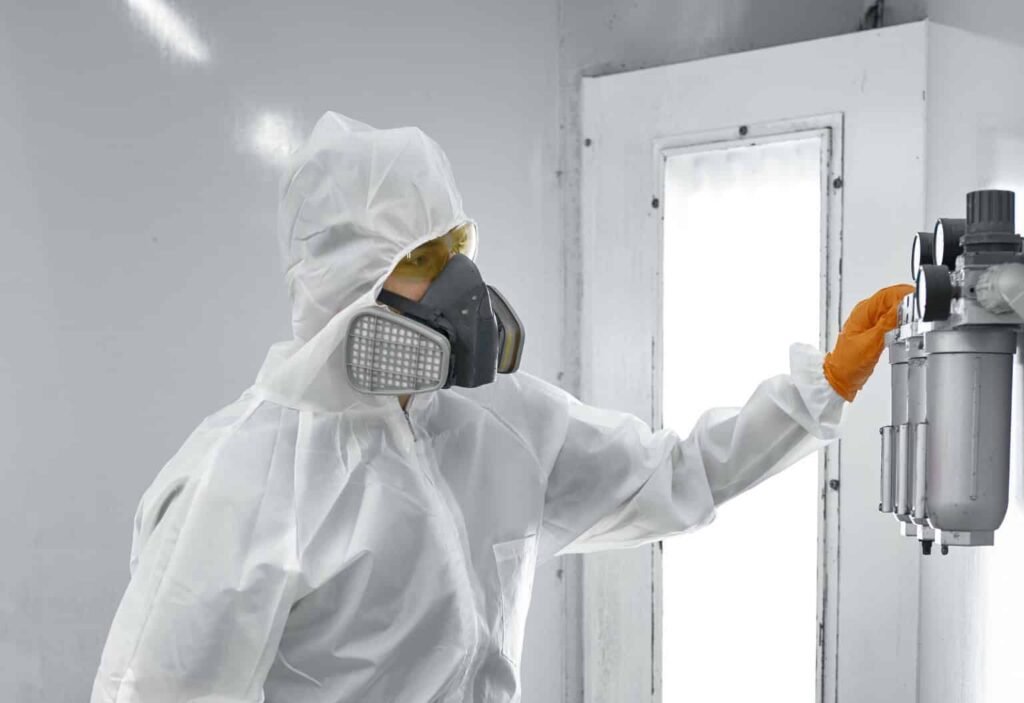
Respiratory protective equipment is the cornerstone of spray operator safety gear. During spraying, operators are exposed to airborne particles and vapours that can cause immediate and long-term harm.
Common respiratory PPE for spray operators includes:
- Air-fed respirators delivering clean, breathable air
- A combination of negative and positive-pressure systems to prevent ingress of contaminated air
- Full-face protection to shield both lungs and eyes
Air-fed systems are widely used in industrial spraying because they provide a consistent supply of clean air, independent of ambient conditions within the spray area. They are particularly important when working with high-solids coatings, solvent-based paints, or materials containing hazardous additives. HSE guidance on respiratory protective equipment for spray operations makes clear that air-fed systems are often required where contaminants cannot be adequately controlled by ventilation alone.
Proper maintenance, air quality monitoring, and correct fitting are essential to ensure respiratory PPE performs as intended. Further guidance on respiratory protective equipment for spray applications can be found in official HSE resources.
Take a look at our respirator masks on our website.
Protective coveralls: Shielding the body
Industrial spray environments expose operators to continuous overspray and surface contact with coatings. Protective coveralls form a barrier between the operator and hazardous substances, helping to prevent skin absorption and contamination. Industry guidance also recognises skin contact as a significant exposure route during spray painting, particularly where overspray settles on clothing or uncovered areas.
Key considerations for coveralls include:
- Chemical resistance suitable for the coatings being applied
- Full-body coverage, including arms and legs
- Durability for extended industrial use
- Comfort and mobility to support efficient working
In large manufacturing facilities, reusable or specialist spray coveralls are often selected to balance protection with practicality, particularly for operators working full shifts in spray booths or on large components.
Take a look at our range suitable for spraying here.
Gloves: Preventing skin exposure
Hands are frequently exposed during spraying, cleaning, and equipment handling. Gloves designed for spray work safety essentials help prevent direct contact with coatings, solvents, and cleaning agents.
Effective gloves should:
- Be resistant to chemicals used in spraying and cleaning
- Fit securely without restricting movement
- Be replaced regularly to maintain integrity
HSE guidance notes that not all glove materials offer adequate resistance to solvents and coatings, making correct material selection essential for effective protection.
Eye and face protection: Reducing immediate injury risk
Even when respiratory PPE includes face protection, additional eye protection may be required depending on the spraying setup and risk assessment.
Overspray, splashes, and airborne particles can cause:
- Eye irritation or injury
- Temporary or permanent vision damage
Visors, goggles, or integrated face protection systems help reduce these risks, particularly during manual spraying or when working outside enclosed spray booths.
PPE, compliance, and industrial standards
Across industrial manufacturing sectors, PPE requirements are closely linked to health and safety legislation, industry standards, and internal operating procedures. Employers are responsible for ensuring that suitable PPE is provided, maintained, and used correctly.
For spray operators, this means:
- PPE selected based on safety and risk assessments
- Regular inspection and replacement of worn or damaged equipment
- Training to ensure correct use, fitting, and limitations are understood
UK operators should also refer to HSE guidance on hazardous substances and spraying operations to ensure ongoing compliance.
When PPE is integrated into a wider safety strategy – alongside ventilation, spray booth design, and process controls – it supports both compliance and productivity.
Long-term health protection for spray operators
The effects of inadequate PPE are not always immediate. Many health issues linked to spraying develop gradually, making long-term protection just as important as short-term safety.
Consistent use of appropriate PPE helps reduce cumulative exposure, supporting operator wellbeing over the course of a career in industrial spraying. For manufacturers, this also means fewer incidents, reduced downtime, and a safer working environment overall.
Supporting safer spray operations
At Airblast Limited, we understand the demands placed on spray operators in industrial manufacturing environments. From automotive and renewables to structural steel and infrastructure projects, effective PPE plays a vital role in maintaining safe, compliant spraying operations.
Choosing the right protective equipment, maintaining it correctly, and ensuring operators are trained to use it properly helps protect people, processes, and project outcomes. For organisations operating large-scale or high-risk spray processes, Airblast supports safer operations through technical guidance, equipment expertise, and industry knowledge. Speak to the Airblast team to discuss PPE requirements for your spray environment.